Things I'm Still Figuring Out as a New Etsy Seller
I still remember the sound my phone made the day my first Etsy order came in, the sale and message notification going off at once. For about five seconds I felt like I had crushed it. Then it hit me that I actually had to ship the thing, and I realized I had absolutely no idea what that meant.
I opened my Etsy shop with a plan: make things I liked, list them, wait for orders. Simple enough. What I did not plan for was everything that plan left out. I'm not writing this because I've figured it out. I'm writing it because I'm still trying to figure it out, and I suspect other new sellers are too.
I didn't think about packing or shipping until I had to.
I was so focused on the product itself that packing and shipping felt like an afterthought, something I'd deal with once an order came in. Turns out packing and shipping are part of the product. A customer doesn't just experience the item, they experience the box it arrives in, how well it's protected, whether it feels like care went into it. I didn't think about any of that at the start.
Packing is its own skill, and I'm not great at it yet.
I assumed packing would just be intuitive. It is not. Fitting an irregular item into a box so it survives shipping, doesn't rattle around, and doesn't use six times more tape than necessary is a real skill. I also didn't think about box sizing itself, trying to standardize around a few sizes that fit as many products as possible so I'm not buying and storing a dozen different box dimensions. I didn't plan for that early on, and because of it I sometimes end up cutting my own boxes down to size instead. I've gotten better through repetition, mostly by getting it wrong first. I sometimes still open a finished package and think it needs to be better. I'm not there yet.
Shipping costs quietly eat into everything if you're not paying attention.
I'd heard that Etsy favors listings with free shipping, so I built that into my prices early on, before I'd really weighed anything or thought hard about actual shipping costs. It felt reasonable at the time, unfortunately it wasn’t. Weight, box size, and distance all add up in ways that are easy to underestimate when you haven't shipped much yet, and I'm still recalibrating prices as I learn what things actually cost to send.
I've spent more time than I expected on SEO, and I still don't know if I'm doing it right.
Tags, titles, keywords, the whole world of trying to get a listing to show up when someone searches. I did not expect this to take as much time as it has. I've read guides, tweaked titles, swapped tags, and watched some listings do better and others do nothing at all. I don't have a system yet. I just have a lot of trial and error and a growing suspicion that I'm still missing something obvious.
I'm slowly learning to set up my process instead of starting from scratch every time.
Some of my pieces, like a guitar stand, have irregular shapes that made lining them up under the engraver genuinely difficult. Eventually I built a jig, a cutout the piece could sit inside so it behaved like a simple rectangle I could align easily. Now I can cut, sand, and prep a batch of that piece ahead of time instead of treating each one as its own project. I haven't gotten to the point where I do this for everything. I'm working toward it, piece by piece.
My tools disappear, and I lose an embarrassing amount of time looking for them.
I own three tape measures. I have, more than once, spent thirty minutes looking for one of them in a shop that had gotten messy again. This is not a lesson I've solved. It's a lesson I keep relearning every time the workshop gets cluttered and I tell myself I'll organize it properly. Someday.
None of this is a how-to. I'm not far enough along for that. It's more of a running list of the things I didn't see coming, some I'm slowly getting better at, and some I'm still tripping over regularly.
If you've crossed any of these bridges already, I'd genuinely love to hear what you learned. I met a woman on Instagram early on who generously shared insight that helped me more than any article I'd found, and it made a real difference. If you have something like that to offer, whether it's about packing, pricing, SEO, or just keeping a workshop from swallowing your tape measures, reach out. I'm still learning this as I go, and I'd rather learn it with some company.
I Have Five Boot Jacks for My Two Feet
Fair warning: this is a lame attempt at laughing at the comedy that is sometimes my life as a small shop owner. If you've ever made something you were convinced would sell and then watched it collect dust, this one's for you.
Every product I have ever made was going to be the one.
You know the feeling. You finish a piece, step back, look at it under the shop light at a flattering angle, and think: people are going to lose their minds over this. You list it on Etsy. You write the description. You pick a price that feels reasonable, maybe a little low because you're being humble about it. You post a photo. You wait.
You wait some more.
You check the stats. Three views. Two of them were you.
The Boot Jack Era
The USMC boot jack was going to be a phenomenon. I was sure of it. It's a solid, practical piece - a traditional boot jack design made for Marines who've spent years wrestling off boots that don't want to come off. It has a specific audience. It has a great story. I made several of them.
One person reached out. They asked questions. Good questions. Engaged questions. The kind of questions that end with a purchase. We went back and forth a few times and then, like a ghost, they were gone. No sale. No explanation. Just silence and five boot jacks sitting in my shop judging me.
So I did what any reasonable person would do. I started giving them away. A few went to people who I figured would appreciate them, maybe post about them, maybe tell someone. You let go of the idea that every piece needs to generate revenue. You accept that some of them are investments in the reputation of a shop that currently has only a few reviews, one of which is from a close friend.
At this point I had given away enough of them that I was down to none. Zero boot jacks. The listing was still live, but if anyone had actually bought one I would have had a problem. I figured that was a risk I could live with, because nobody was buying one.
The Part Where It All Goes Wrong
Then a funny thing happens.
Someone buys one. Then someone else buys one. Back to back. The shop that could not give boot jacks away is now a boot jack empire with a processing time clock that Etsy takes very personally and exactly zero boot jacks on hand to ship.
This is the part they don't put in the small business content. Not the "I scaled my side hustle" part. The part where you're in the garage at 10pm trying to remember exactly how you made them, building against a deadline you created for yourself, hoping the finish dries before the shipping window closes.
There is a specific kind of stress that comes from success arriving slightly faster than your ability to handle it. It's not a bad problem to have but it is absolutely still a problem.
The Cycle, Explained
For anyone thinking about selling handmade goods, here is an accurate description of the cycle as I have experienced it:
You make something. You’re certain it will sell. It does not sell. You question your abilities, your taste and your choice to do any of this at all. You give the things away. The things sell. You have none. You build more in a mild panic. Somebody asks if you do custom sizes. You say yes. You should not have said yes. You figure it out. The custom size ships. You get a nice message from the buyer. You feel great. You make something new. You are certain it will sell.
Repeat.
What I've Actually Learned
The honest version: I have no idea what's going to sell. I thought the boot jack was obvious. I thought the charcuterie board was obvious. I thought the planter was a long shot and it sold first. The market has opinions that don't always line up with mine, and the sooner I accept that, the better I’ll sleep.
What I do know is that the pieces I've put the most care into are the ones that eventually find the right person. Part of that is slowing down and paying attention because the wood seems to tell you what it wants to be. A piece with interesting grain, a natural edge, a color that surprises you when it hits the finish, those pieces have a direction. Follow it, put in the time, and they go. Maybe not the first week. Maybe not the third. But they go.
The boot jacks are gone now, for what it's worth. All but one. The ones I sold, the ones I gave away, and the ones I built in a panic at 10pm. Somewhere there are Marines pulling off their boots with something I made in a garage in Mountain View, and that's not a bad outcome for a project that once had a view count of three - two of them me.
I'm already sure the next one is going to be huge.
Know your Wood
What’s Actually in that cutting board?
Let me be clear upfront: I am not a scientist, a food safety expert, or a chemist. I’m just a guy in a garage workshop who tries to do right by the people who buy things I make. Risk is everywhere - the more you read about food safety, the more you realize everything seems like it's out to get you. But some risks are easy to avoid, and using wood with an unknown history on a food-contact surface is one of them.
You often see someone post a beautiful cutting board or kitchen piece in a woodworking community, someone asks about the wood or the finish, and the maker shrugs. A good example is someone repurposing wood from old church pews - a great idea in principle, but old wood like that could have decades of varnish, paint, or other treatments soaked into the grain that no amount of sanding will fully remove. I've been guilty of not thinking things through myself, and I'll share one of those moments below.
The Wood Itself
Most woodworkers use maple, walnut, or cherry for cutting boards and kitchen items. These are tight-grained hardwoods that resist moisture and have well-established records as food-safe species. The FDA's Food Code permits cutting boards made from maple or similar close-grained hardwoods, and the USDA's guidance confirms that wood is an accepted material for home kitchen use.
The problem comes when the wood's origin is unclear or when it's been repurposed. Pallet wood is a common one - it can be cheap or even free, it photographs well, and reclaiming materials is admirable. But pallets used in international shipping can be treated with methyl bromide, a fumigant, and there's no reliable way to tell from the surface. The HT stamp means heat-treated, which is safer, but you're still trusting the stamp. Reclaimed flooring, furniture, or architectural salvage raises similar questions about what finishes or treatments the wood may have absorbed over its life.
If you want to dig into species-specific information - toxicity, grain characteristics, known issues - the Wood Database (wood-database.com) is a useful resource. It's where I go when I'm working with something less common.
A Mistake I Almost Made
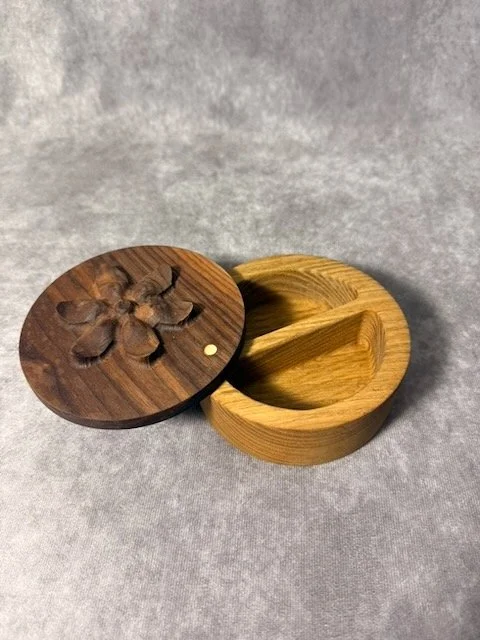
I made a salt cellar out of sassafras a while back. The body was sassafras, the lid was walnut - a 2.5D carved lotus flower on top, held in place by a brass rod I had inserted through the lid and into the body. It came out beautifully. Then I did what I should have done before I started: I looked up the species. Sassafras contains safrole, a compound the FDA banned as a food additive in the 1960s after studies raised safety concerns. The research on whether the wood itself poses meaningful risk at the exposure levels of a small salt cellar isn’t conclusive - the amounts involved are likely minimal - but I decided I wasn't comfortable selling it as a food-contact item. I still have the piece. I may sell it eventually, clearly marked as decorative and not for food use.
I'm not telling that story to make myself sound responsible. I'm telling it because I almost didn't look it up. Five minutes of research would have saved me the decision entirely.
The Finish
You can start with a well-documented food-safe species and still end up using the wrong finish.
Some in the woodworking community argue that any finish is food-safe once it's fully cured. I can't dispute that from a scientific standpoint - I haven't run any experiments and I'm not qualified to evaluate chemistry. What I can say is that "fully cured" is doing a lot of work in that argument. Full cure for some finishes can take weeks, and there's no standardized definition of what it means in practice for a surface that will see knives, moisture, and acidic foods daily.
I prefer to sidestep the debate and use what's already considered food-safe: food-grade mineral oil, beeswax, carnauba wax, and combinations of those. They require occasional re-application, but that's appropriate maintenance for something that touches your food. That's what goes on anything food-contact I make, no questions asked.
Resources
The USDA's cutting board guidance is worth a quick read: fsis.usda.gov. One note - it mentions that solid wood boards can be washed in a dishwasher. Technically possible, maybe, but the heat and prolonged moisture will warp and crack a wood board over time. Hand wash, dry promptly, re-oil occasionally. That's the standard advice and it's what works.
I'm still learning. I'll probably make more mistakes. But I'm looking things up before I start now, not after I've already built the thing.
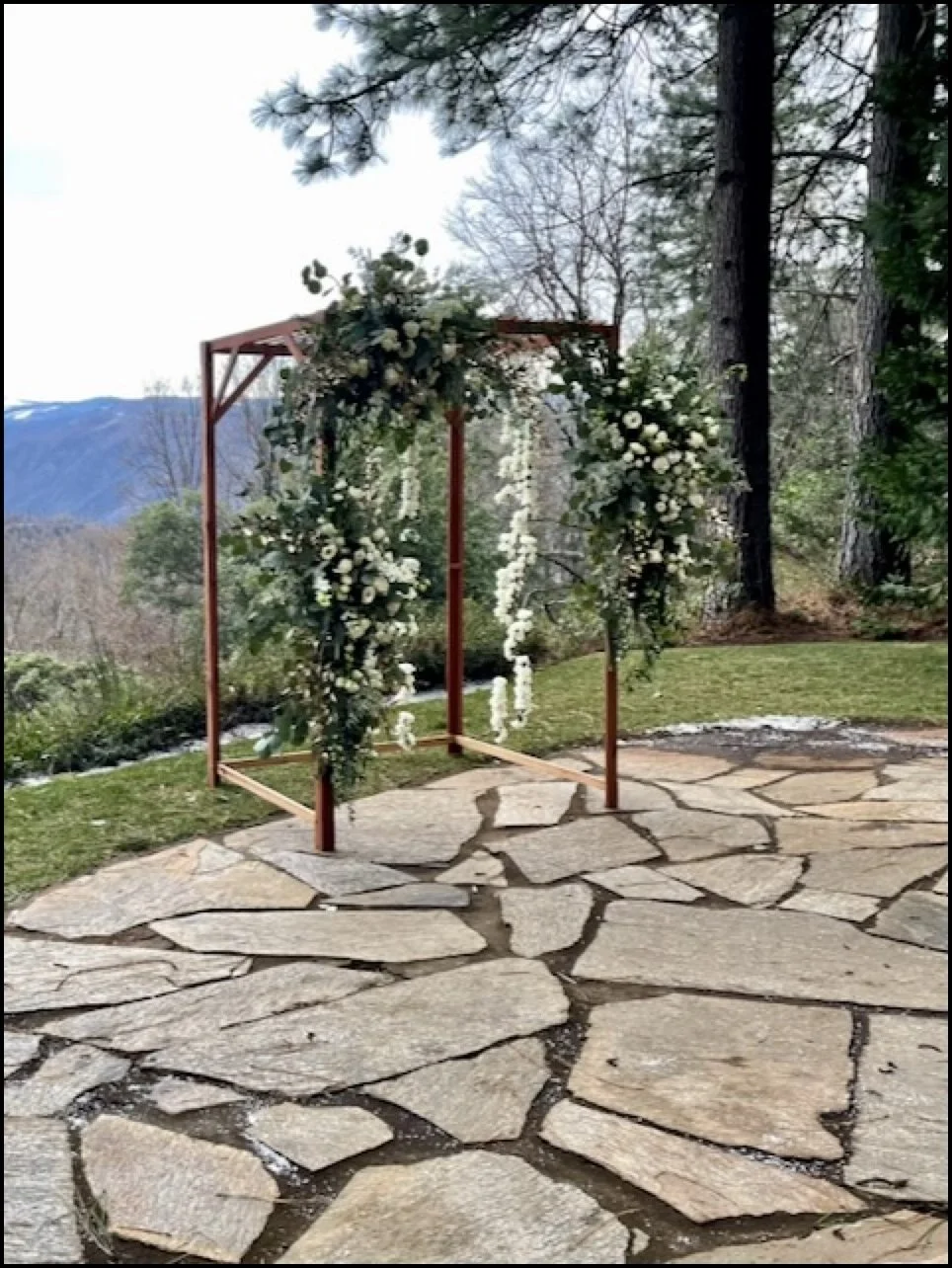
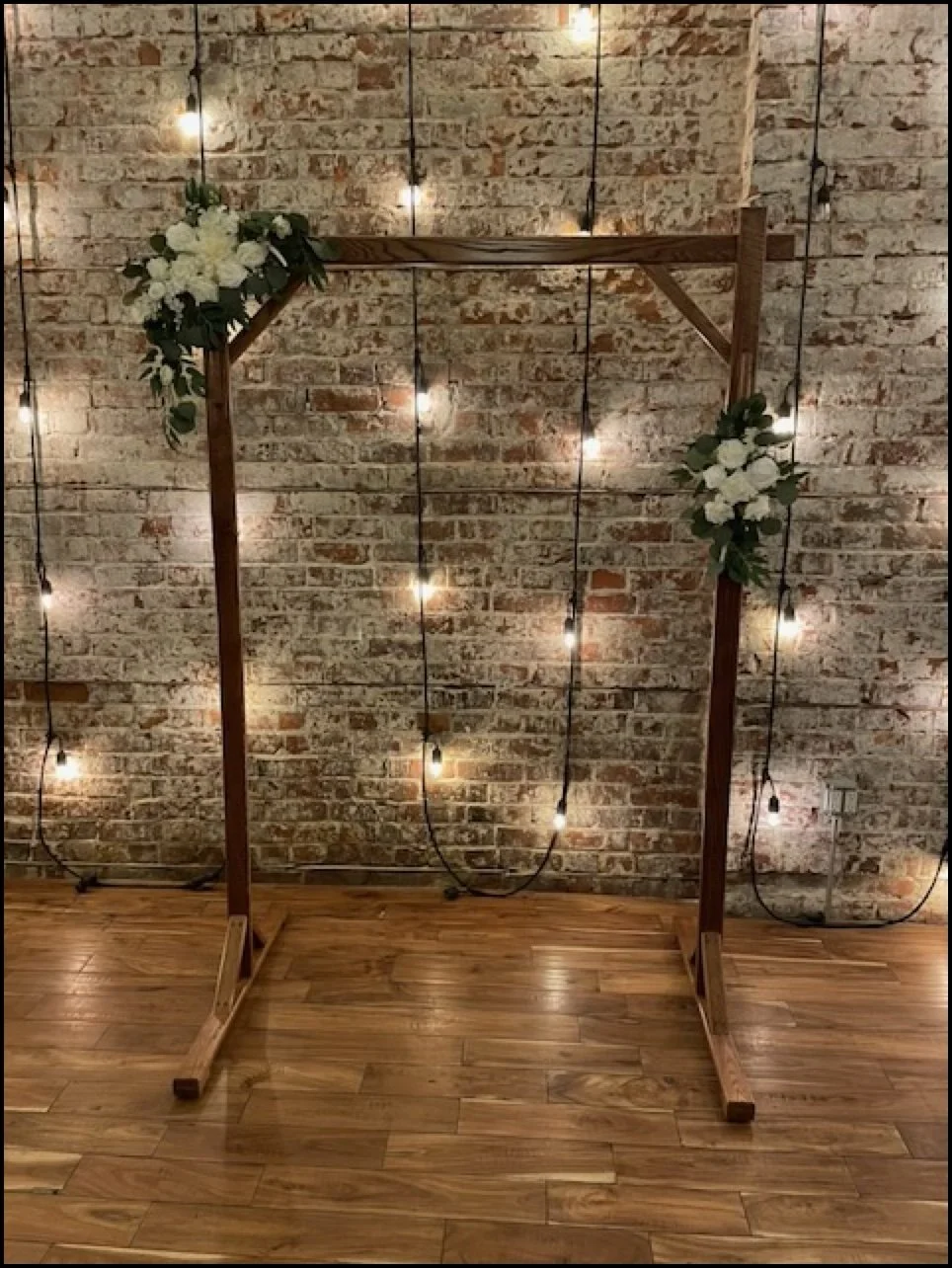
The Arches
I've made two wedding arches.
The first one I built entirely with hand tools. At the time that's where I was in my shop, there was no philosophical reason behind it, just the tools I was working with. My niece got married under it, and after the reception the venue made an offer and bought it. Last I checked, it's still there. I've seen it in photos on their website, other couples standing under it, other families gathered around it. Nobody in those photos knows anything about where it came from or who built it, and that's fine. That's actually kind of the point of making something well. It goes out into the world and does its job without you.
The second arch I built with power tools, a different stage of the shop, different build, same intention. I was making something worthy of the moment it was made for. This one was for a different niece, and somewhere in the middle of all of it, while the arch was still being planned, she asked me something I didn't see coming. She asked me to marry them.
Not in the general sense. She wanted me to officiate, to stand at the arch I had built and perform the ceremony. I got ordained to do it, and before you picture me disappearing into a monastery for six months, I'll save you the image. It wasn't like that. The process was straightforward. What wasn't straightforward was standing at that arch on her wedding day, knowing I had built the thing I was standing at, knowing what it meant to her, and to me, that I was there in that role.
All of my nieces and nephews call me nino, their kids too, some of them. That's not something I asked for. It's just what happened over time, which is the best way for something like that to happen. When she asked me to officiate I understood it as the same thing, not a formal designation, just family deciding what family means to them and acting accordingly.
The arch she was married under is in her home now. The first one is still at the venue, showing up in strangers' wedding photos. Two arches, two nieces, both still standing somewhere doing what they were built to do.
I don't always know what a piece is going to mean when I start building it. With a cutting board or a trivet you have a pretty good idea. With an arch you know it's significant, but you don't know exactly how significant until you're standing at it in a suit watching your niece walk toward you. That one I didn't see coming either.
The Chopsticks
I don't talk about this much. But I'm going to try.
A few years ago, the most important parts of my life began slipping away, gradually, quietly, until one day I woke up and realized how different everything had become.
We go through life almost as if there's a series of steps that will get us to where we think we belong. We follow them, we check the boxes, we build something. And then life happens, the kind of events that change everything, and we find ourselves not nearly as prepared as we thought we were.
I looked around and didn't recognize anything that used to define me. The identity I had spent decades building didn't feel like it was mine anymore.
My first instinct was to overwrite it. Start fresh. Become someone new. But that's not really how it works, is it?
I've been around woodshops since high school. A shop teacher pointed me toward an after-school job that changed how I saw what hands could do. Then came the Marine Corps, then a paralegal certification I never used, then a long career in tech and cybersecurity. Wood got set aside, for a long time.
When the difficult chapter hit, I needed something to do with my hands. Something real. Something that required me to focus on the thing in front of me and nothing else.
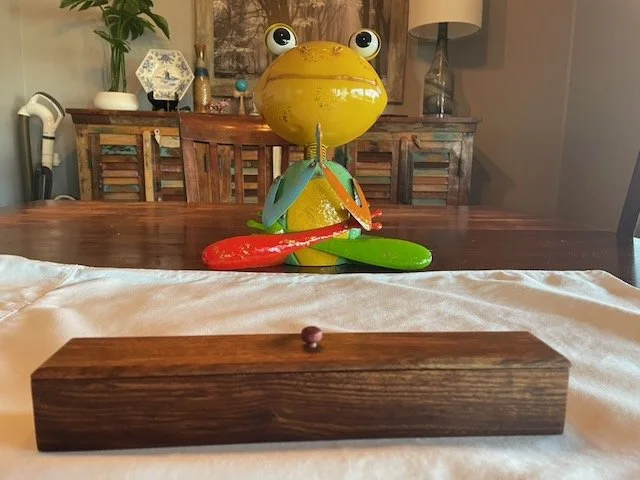
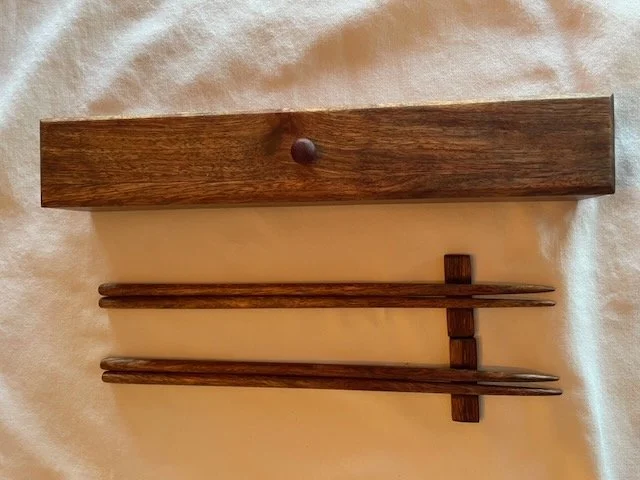
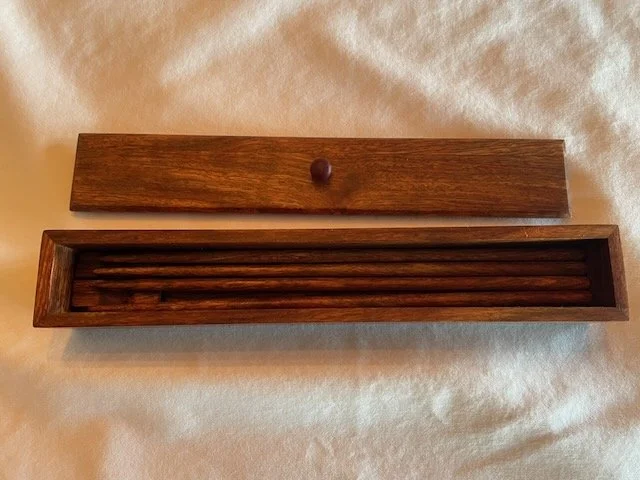
My son is a chef, he was living far away at the time and I missed him more than I could express, even now. I decided to make him a chopstick set, chopsticks and a box.
I didn't have a lathe and I didn't really know how to make chopsticks. I used my drill as a makeshift lathe and shaped them by hand. They weren't perfect but making them made me feel close to him in a way that a phone call couldn't.
He uses them at home in his kitchen. That's enough for me.
Around that time I went to Oaxaca. It was my first time there. I felt as though I needed to go somewhere that wasn't here, somewhere that might help me breathe differently.
While I was there I spent time with a curandero, a traditional healer. We talked and he suggested I do a limpia, a cleansing. A couple of days later I participated in a temascal, a traditional sweat ceremony, with him and a group of others. It was one of those experiences you can't fully explain to someone who wasn't there. I go back to those memories often.
He said something I've carried with me since. El que no suelta, no sana. He who doesn't let go, doesn't heal.
I came back carrying that with me. And I kept building.
The shop grew, a garage in Mountain View, listed as two-car though it doesn't feel like it. I added tools. A table saw. A CNC router. A laser engraver. Skills I thought I had lost have come back, and new ones have taken root alongside them.
I thought for a while that I was supposed to rebuild myself into someone completely different. But somewhere along the way I realized that wasn't right either. I carry a lot of the old me with me, the Marine, the engineer, the kid who learned to love wood in a high school shop class. I'm not replacing any of that. I'm just on a different path now.
And lately, for the first time in a while, I'm starting to see a new version of happy emerge.
Each piece I build goes into someone's home. Part of someone's life. A trivet on a kitchen counter. A guitar stand in a living room. A charcuterie board on a table where a family gathers.
I care about that more than I expected to. Because every time I finish a piece and it leaves the shop, I remember what it took to build the person who made it.
It's not the shop I envisioned. But it's mine, and it's my garage.
I'm just getting started.
— Angel