Know your Wood
What’s Actually in that cutting board?
Let me be clear upfront: I am not a scientist, a food safety expert, or a chemist. I’m just a guy in a garage workshop who tries to do right by the people who buy things I make. Risk is everywhere - the more you read about food safety, the more you realize everything seems like it's out to get you. But some risks are easy to avoid, and using wood with an unknown history on a food-contact surface is one of them.
You often see someone post a beautiful cutting board or kitchen piece in a woodworking community, someone asks about the wood or the finish, and the maker shrugs. A good example is someone repurposing wood from old church pews - a great idea in principle, but old wood like that could have decades of varnish, paint, or other treatments soaked into the grain that no amount of sanding will fully remove. I've been guilty of not thinking things through myself, and I'll share one of those moments below.
The Wood Itself
Most woodworkers use maple, walnut, or cherry for cutting boards and kitchen items. These are tight-grained hardwoods that resist moisture and have well-established records as food-safe species. The FDA's Food Code permits cutting boards made from maple or similar close-grained hardwoods, and the USDA's guidance confirms that wood is an accepted material for home kitchen use.
The problem comes when the wood's origin is unclear or when it's been repurposed. Pallet wood is a common one - it can be cheap or even free, it photographs well, and reclaiming materials is admirable. But pallets used in international shipping can be treated with methyl bromide, a fumigant, and there's no reliable way to tell from the surface. The HT stamp means heat-treated, which is safer, but you're still trusting the stamp. Reclaimed flooring, furniture, or architectural salvage raises similar questions about what finishes or treatments the wood may have absorbed over its life.
If you want to dig into species-specific information - toxicity, grain characteristics, known issues - the Wood Database (wood-database.com) is a useful resource. It's where I go when I'm working with something less common.
A Mistake I Almost Made
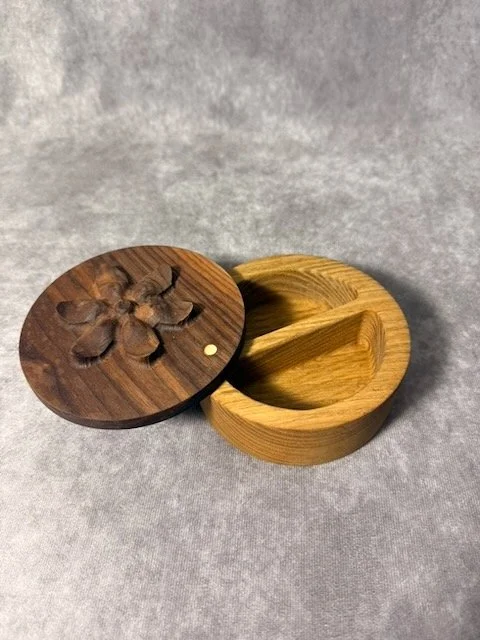
I made a salt cellar out of sassafras a while back. The body was sassafras, the lid was walnut - a 2.5D carved lotus flower on top, held in place by a brass rod I had inserted through the lid and into the body. It came out beautifully. Then I did what I should have done before I started: I looked up the species. Sassafras contains safrole, a compound the FDA banned as a food additive in the 1960s after studies raised safety concerns. The research on whether the wood itself poses meaningful risk at the exposure levels of a small salt cellar isn’t conclusive - the amounts involved are likely minimal - but I decided I wasn't comfortable selling it as a food-contact item. I still have the piece. I may sell it eventually, clearly marked as decorative and not for food use.
I'm not telling that story to make myself sound responsible. I'm telling it because I almost didn't look it up. Five minutes of research would have saved me the decision entirely.
The Finish
You can start with a well-documented food-safe species and still end up using the wrong finish.
Some in the woodworking community argue that any finish is food-safe once it's fully cured. I can't dispute that from a scientific standpoint - I haven't run any experiments and I'm not qualified to evaluate chemistry. What I can say is that "fully cured" is doing a lot of work in that argument. Full cure for some finishes can take weeks, and there's no standardized definition of what it means in practice for a surface that will see knives, moisture, and acidic foods daily.
I prefer to sidestep the debate and use what's already considered food-safe: food-grade mineral oil, beeswax, carnauba wax, and combinations of those. They require occasional re-application, but that's appropriate maintenance for something that touches your food. That's what goes on anything food-contact I make, no questions asked.
Resources
The USDA's cutting board guidance is worth a quick read: fsis.usda.gov. One note - it mentions that solid wood boards can be washed in a dishwasher. Technically possible, maybe, but the heat and prolonged moisture will warp and crack a wood board over time. Hand wash, dry promptly, re-oil occasionally. That's the standard advice and it's what works.
I'm still learning. I'll probably make more mistakes. But I'm looking things up before I start now, not after I've already built the thing.